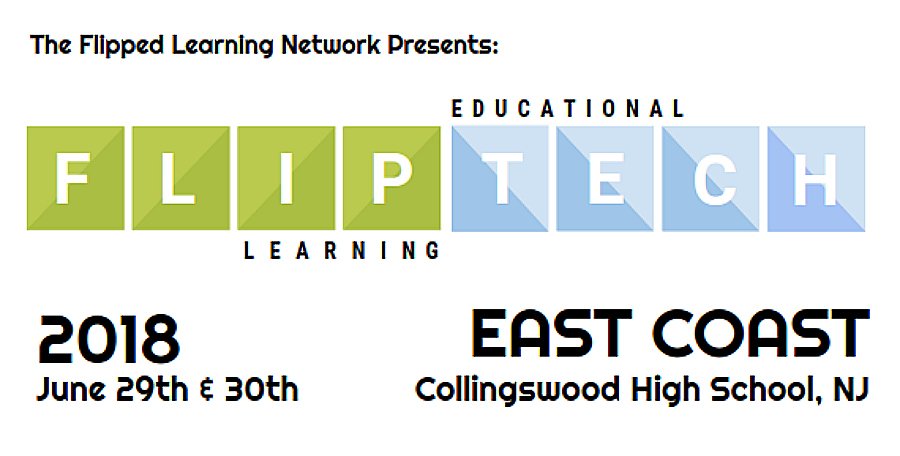
 From June 28th - July 1st I was in New Jersey attending FlipTech East Coast 2018 - And one of the questions that I was asked repeatedly was Why? ... Why did I travel all the way to New Jersey for a tech conference? Well, let me start with how this even began...
Around mid-May I was on Twitter participating in a Twitter chat when I noticed a tweet giving away two scholarships to attend @FlipTechEC - and truth be told, as I applied immediately, I did not pay attention to the EC part - All I thought was, “Hey, Why Not?! Free conference? Yes, please.”
Seconds after I hit submit on that Google Form I get a tweet from @spEDTECHer - I responded (of course)...

Then it happened. I got an email stating: Congratulations! FlipTech East Coast would like to extend a FREE invitation for you to attend our exceptional conference taking place on Friday, June 29th and Saturday, June 30th at Collingswood High School in Collingswood, NJ.
Again...Why Go? Because I do believe that maybe not Everything, but Many Things Happen for a Reason. With that being said, what an amazing opportunity to be invited across the country to join other educators who are interested, curious, and passionate about Flipped Learning. Anyone could have been chosen, and that anyone was me.
Unfortunately, there are not many technology events for teachers in my neck of the woods, let alone for teachers who want to Flip. In order to attend a summit, conference, or EdCamp I need to travel quite a distance - and with CA traffic the commute is even longer than what it should be. They are also very expensive - If I’m going to fork out my own hard earned cash for professional development (my own personal learning) then I might as well make it worthwhile.
And I Did!
From start to finish the committee, including lead organizer @collsphysistry of #FTEC18 ran the function smoothly. They thought of everything!
Before I left CA there was
a Digital Conference Program with links to interviews with the presenters. Loved This - I was able to map out my schedule and “meet” the people who were presenting before the first day. This really helped me gauge what sessions would be in my best interest - It’s always a bummer walking into a session blind and feeling like you are stuck - This time I had a better idea of how I would be spending my time.
When I arrived in New Jersey
I was nervous to meet other people, despite my big mouth and loud thinking, I can be quiet and shy in a room full of strangers.
During my first morning I joined @KyleNiemis and another teacher at a table for breakfast talk. So far so good...friendly people. When lunch came I had the pleasure of sitting with three wonderful women (I'd like to mention @MrsFisher19 and @DOminiakSCIENCE here) who took me in and quickly made me a part of their group. By Day 2 I was offered rides to and from my hotel and was invited to additional social gatherings. I completely felt like I was part of this tribe ≛ PLN.
#FTEC18 had A Lot to Offer
DAY1
↦ The Key-Notes were so on point! @ChemicalSams & @EmergingEdTech had two different messages, but were completely relevant in their own right. Being a teacher is not just about being the one who delivers the content...it is the person who can help our students become owners of their learning - Creators of a Student Centered environment. And as facilitators don't focus on the middle - "Design for the fringe and all...will benefit."
↦ "Balancing Tech with Our Young Digital Citizens" with @EricaRipston: At the beginning of the year survey parents about what tech looks like at home (maybe at Back To School night). Through a session conversation it hit me that yes, the adults at home are also models, however, it looks like we, as teachers, need to include them in lessons about basic digital citizenship and why it is important to un-plug once in awhile.
↦ "In Class Flip: Understanding the Logistics Behind the Flip" with @MarthaRamirezco and @CRbuitrago: This duo is awesome - Absolultely loved learning from these two educators from Colombia. They are so smart...They applied one of their techniques to the delivery of this session. Participants were able to immerse themselves in a rotation model while learning about how to incorporate an IN CLASS FLIP. Even though they teach adult learners I was able to relate to this process. With 30 students I can just duplicate the stations making it manageable (ie. do two station #1s).
↦ "Crafting Autonomous Learners with Hyperdocs and Flipped Learning" with @CRbuitrago: Enjoyed learning from Carolina so much that I had to stick around for another round. She teaches English to adults and uses Hyperdocs to do so. I feel that ELA/ELD content is my strongest area and to see all the different ways to use a hyperdoc model to teach grammar was so beneficial. I'm definitely checking out ThingLink and DeckToys for next year - a creative spin on Hyperdocs.
↦ "Flipping the Pre-Laboratory Introduction in the Science Classroom" with Robert King: Even though the wi-fi was down we were still able to see examples by the verbal sharing of YouTube links (I always say that tech is like magic...AND I adore magic so much).
On my phone I viewed a quick video
-------->
While I'm gradually implementing NGSS and transforming what science instruction looks like in an elementary classroom I can generate videos that prep my young learners and give them the confidence they need to follow through with a hands-on excercise - ultimately Building that Student Agency.
↦ Student Panel: This is the first ever student panel I have seen at a conference. It was comprised of AP Chemistry students at Collingswood HS. These particular students are very active and involved in extra-curricular activities. As a traveling athlete, having access to wifi on the school bus is a must...Students who don't get home until well after dinner on a school night due to school functions away from home base can still get work done. There is also more time during the class period to receive help and clarification if needed. Downfall, not all students will take advantage or have the capabilities to partake in a Flipped Learning setting.
↦ Viewing of "Most Likely to Succeed": Day 1 couldn't have ended any better. Every parent, guardian, and educator should see this film. Talk about giving students choice and voice...this is the window to which we are all looking for - What many of us are attempting. If education actually supported this type of learning experience what would the future hold? Thinking about the year that I had and the group of third graders I closely worked with brought tears - Yes, I cried (publicly I might add). But it's hard not to feel responsible for the future of our students when you are sometimes the only direct role model they have for 180 days. I was honored to be asked to help with a discussion after the movie by @spEDTECHer and wished the conversations could continue, but it was late and we all needed a break.
DAY2
↦ FlipCamp (EdCamp style): What a brilliant idea...one day of conference is tiring in itself so being able to have something light on the second day was, lack for some better words, a good idea. There were a variety of sessions (formal, directed, and attendee driven). Because I didn't join in any of the sessions by @matthew_t_moore I decided to hang with a group that he assisted. I enjoyed having someone to help guide the conversation and even share their personal thoughts on Flipped Learning.
Conferences: CA v. New Jersey
It was so interesting to me that I was pretty much the only elementary teacher at this conference AND the majority of teachers who were in attendance were NOT ELA teachers. Most of my experiences with tech conferences have been where the participants are mostly primary teachers and the sessions are focused on apps used for reading and writing.
I was pleasantly surprised by this phenomena. It gave me a new hope and validated the way I am using technology within my own classroom...across subject areas.
Why Did I Go To #FTEC18?
Why Did I Go To #FTEC18?
I hope it's clear by now why I decided to spend time and money on a conference being held on the other side of this country (literally). If not, read a little further:
As an educator and someone very fond of learning I am constantly trying to better myself so that I can be the best for my students. Yes, I teach 3rd grade and Yes, we have 1:1 chromebooks in the classroom...This means that I need to find meaningful ways to use this tool in conjunction with the curriculum so that students are mastering the standards. Does it have to be cookie cutter? Does it look the same for every student, every teacher? I am growing my PLN (something I knew nothing about a year ago) and finding ways to bring real-life learning into an elementary school classroom. Yes, students will be using technology in high school, even middle school, but if I can better prepare these young scholars for what they will be exposed to in 4-6 years from now, then I should. The point of school is not to test, not to memorize, but to be prepared for and succeed the next year, and the year after that.
As an educator and someone very fond of learning I am constantly trying to better myself so that I can be the best for my students. Yes, I teach 3rd grade and Yes, we have 1:1 chromebooks in the classroom...This means that I need to find meaningful ways to use this tool in conjunction with the curriculum so that students are mastering the standards. Does it have to be cookie cutter? Does it look the same for every student, every teacher? I am growing my PLN (something I knew nothing about a year ago) and finding ways to bring real-life learning into an elementary school classroom. Yes, students will be using technology in high school, even middle school, but if I can better prepare these young scholars for what they will be exposed to in 4-6 years from now, then I should. The point of school is not to test, not to memorize, but to be prepared for and succeed the next year, and the year after that.
Because I attended this conference I will forever be reminded that "We must not only teach students to know and to do, but also to be." There are so many definitions for Flipped Learning, but "there is no right way" or THE way to do it - Only YOUR Way. Start small and find methods that compliment your teaching style and your students' needs - You can make it work...Why? (hope the message is clear) Because EdTech is NOT going away nor the idea of Flipped or Blended Learning.
☆ Build Your PLN (there are so many shout-outs in this text and there are more that I did not mention:@flipping_A_tchr & @MrsStephenson3 & @DynamicDuda338 & @mollywmus), Communicate with others (ask questions and share ideas), Collaborate with educators outside of your space (webinars, video chats, Travel!), Be Creative on how you deliver content/standards (use YouTube and Hyperdocs), and most of all Be a Critical Thinker (EdTechTeam Blog: Critical Thinking). Aren't these the expectations we have of our students?
☆ Build Your PLN (there are so many shout-outs in this text and there are more that I did not mention:@flipping_A_tchr & @MrsStephenson3 & @DynamicDuda338 & @mollywmus), Communicate with others (ask questions and share ideas), Collaborate with educators outside of your space (webinars, video chats, Travel!), Be Creative on how you deliver content/standards (use YouTube and Hyperdocs), and most of all Be a Critical Thinker (EdTechTeam Blog: Critical Thinking). Aren't these the expectations we have of our students?


